pattern coating
Pattern coating is a specialized adhesive application process that creates a defined, non-uniform coating geometry on the substrate, such as stripes, grids, dots, or custom shapes, rather than a continuous full-width layer. This technique is used to achieve specific functional benefits, including controlled bonding, breathability, decorative effects, or material savings. Pattern coating is essential in products like breathable medical dressings, pressure-sensitive labels with patterned adhesive for easier removal, and packaging with selective seal areas. This article provides a comprehensive technical overview of pattern coating methods, equipment, process control, and applications.
Pattern coating can be achieved through several distinct techniques, each suited to different adhesive viscosities, line speeds, and pattern resolutions. Gravure coating is the most common method for fine patterns; the engraved cylinder features cells or channels that correspond to the desired pattern, and a doctor blade wipes the smooth areas, leaving adhesive only in the engraved regions. The pattern can be a continuous stripe, a dot matrix, or a complex geometric design. The cell depth and shape control the coat weight per unit area. Slot die coating can also produce patterns by using a die with a segmented slot or by using a shim with openings that define the pattern; the adhesive flows only through the open sections. However, slot die patterns are typically limited to stripes or simple shapes because the flow distribution becomes non-uniform at the pattern edges. Roll coating with a patterned roll (e.g., an anilox roll with a specific cell pattern) is similar to gravure. Screen printing can apply thick adhesive patterns on various substrates, but is slower and more suited for offline or sheet-fed operations. Spray coating can be patterned by using masks or by modulating the spray pattern, but resolution is lower.
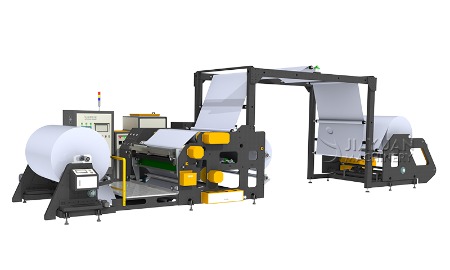
Adhesive coating machine
The design of the pattern is critical for achieving the desired functional outcome. For a pressure-sensitive adhesive label with a "dot" pattern, the adhesive coverage (percentage of area coated) typically ranges from 20% to 80%. A lower coverage reduces tack and allows repositionability, while higher coverage increases bond strength. The dot size, spacing, and shape (round, square, or diamond) affect the peel adhesion and shear resistance. For breathable medical dressings, a grid or stripe pattern allows moisture vapor to escape while providing sufficient adhesion to the skin. For packaging seals, the pattern may be a continuous stripe around the perimeter of a pouch, with an uncoated center to keep the product free. The pattern must be precisely registered to the substrate or to other printed features. The coat weight in the coated areas must be uniform to ensure consistent performance. The edges of the patterned features must be clean and free of raggedness or adhesive bleeding.
Process control for pattern coating focuses on the accuracy of the pattern geometry and the coat weight in the coated areas. For gravure pattern coating, the key parameters are the engraved cell volume, the doctor blade pressure and angle, the speed ratio between the cylinder and the substrate, and the viscosity of the adhesive. The cell volume is fixed by the engraving; however, the transfer efficiency can vary with viscosity and speed, affecting the coat weight. The doctor blade must be sharp and properly set to wipe excess adhesive without damaging the cylinder. For slot die pattern coating, the shim opening must be precisely cut, and the die lip must be straight to avoid flow disturbances. The valve timing (for intermittent patterns) must be synchronized with line speed. Inline inspection systems, using cameras with appropriate lighting, can detect pattern defects such as missing dots, smearing, or misregistration. Closed-loop control can adjust the valve timing or the cylinder speed to correct deviations. The coating head must be cleaned regularly to prevent pattern clogging, especially for gravure cylinders with fine cells.
Pattern coating offers significant advantages over full-width coating. It reduces adhesive consumption, which lowers material cost, especially for expensive PSAs. It enables products with tailored properties, such as "easy-peel" labels with low-tack patterns, or double-sided tapes with adhesive only on the edges for clean removal. It improves breathability in medical and hygiene products, enhancing wearer comfort. It can also create aesthetic effects, such as transparent windows in decorative tapes. However, pattern coating imposes tighter tolerances on equipment and process control. The engraved cylinders or shims are costly and specific to each pattern, limiting flexibility. Changeover to a different pattern often requires changing the cylinder or die, which can be time-consuming. The trend in pattern coating is toward more flexible methods, such as digital printing of adhesives (inkjet-like), which allows pattern changes without physical tooling, though current speeds and coat weights are limited. For high-volume production, gravure remains the dominant method. In summary, pattern coating is a powerful technique that adds value by precisely controlling where adhesive is placed, enabling innovative product designs and significant material savings, and its use is expanding in medical, label, and packaging applications.