precision coating
Precision coating refers to the application of adhesive or functional coatings with exceptionally tight tolerances on coat weight and thickness uniformity, typically within ±1-2% of the target value. This level of accuracy is essential for high-value products such as medical patches, optical films, electronic adhesives, and high-performance tapes, where even minor variations can compromise functionality, reliability, or regulatory compliance. Precision coating requires advanced equipment, meticulous process control, and a deep understanding of fluid rheology and substrate interactions. This article provides a comprehensive technical overview of precision coating technologies, key parameters, control strategies, and applications in the adhesive industry.
The foundation of precision coating lies in the coating method and the metering system. Slot die coating is widely recognized as the most precise method for adhesive application, achieving coat weight uniformity within ±1% and thickness variation below ±0.5 µm for many formulations. The closed die system, combined with positive displacement gear pumps, provides accurate volumetric metering that is largely independent of viscosity fluctuations. Gravure coating can also achieve high precision for very thin coatings (0.5-5 gsm) with uniformity within ±2-3%, provided that the engraved cylinder is precisely manufactured and maintained. Reverse roll coating, with its shearing action, offers precision within ±2% for medium-viscosity fluids. Comma blade coating, when properly set and maintained, can achieve ±2-3% uniformity for water-based and solvent-based adhesives on paper and film. The selection of the coating method is the first critical decision in achieving precision coating, and it must be matched to the adhesive rheology, substrate, and target coat weight.
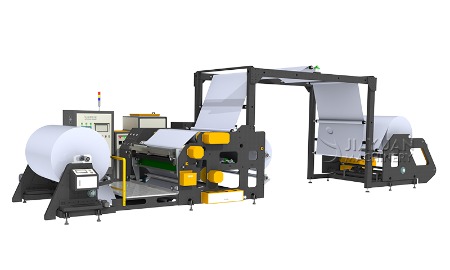
Adhesive coating machine
Key parameters that define precision coating include coat weight accuracy, cross-web uniformity, and machine-direction consistency. Coat weight accuracy is the deviation of the average coat weight from the target, typically expressed as a percentage or absolute value (e.g., ±0.2 gsm). Cross-web uniformity is the variation across the width, measured as the standard deviation or range of the coat weight profile. Machine-direction consistency is the variation over time, often characterized by the standard deviation of consecutive gauge readings. For precision coating, the combined variation (total process capability) must meet a Cpk value of 1.33 or higher, indicating that the process is centered and the spread is within the specification limits. Achieving this requires not only a precise coating head but also stable substrate properties, consistent adhesive viscosity, and a control system that can compensate for disturbances in real time.
Control strategies for precision coating involve multiple layers of feedback and feed-forward control. The primary control loop uses an online gauge (beta-ray, X-ray, or near-infrared) to measure the coat weight after the drying or cooling section. The gauge reading is fed back to the pump speed controller (for slot die) or to the gap actuator (for blade or roll coaters) to correct any deviation. The control algorithm typically uses PID (proportional-integral-derivative) with predictive elements to account for the transport delay between the coating head and the gauge. For cross-web uniformity, advanced slot dies are equipped with thermal actuators (heated bolts) that can locally adjust the lip gap based on the profile data from the scanning gauge. This profile control can correct center-thick, edge-thick, or other non-uniform patterns. Additionally, feed-forward control uses measurements of incoming substrate properties (e.g., thickness, tension) and adhesive temperature to preemptively adjust the flow rate, reducing the impact of disturbances before they affect the coating. Some systems also incorporate machine learning algorithms that learn the process dynamics and optimize control parameters for different products and conditions.
Factors that can compromise precision coating include adhesive viscosity drift, substrate thickness variation, temperature gradients, and mechanical wear. Viscosity drift, caused by temperature changes or solvent evaporation, alters the flow rate through the coating head; precise temperature control (within ±0.5°C) and closed-loop viscosity control (using inline viscometers) are essential. Substrate thickness variations can cause apparent coat weight changes if the gauge measures total mass; differential gauging (measuring substrate before coating and subtracting) or using a gauge that directly measures the coating layer is required. Temperature gradients across the die cause differential thermal expansion, altering the lip gap; multi-zone die heating with independent sensors and heaters maintains uniformity. Mechanical wear of die lips, rolls, or bearings introduces geometry changes that affect coating thickness; regular maintenance and periodic re-grinding of critical surfaces are necessary. In precision coating, every component and process variable must be scrutinized and controlled to achieve the required tolerances.
Applications of precision coating are found in industries where adhesive performance is critical and failure is costly. In the medical sector, transdermal patches require coat weight accuracy within ±2% to deliver the correct drug dosage through the skin. In electronics, adhesives for flexible circuits and display films must have uniform thickness to ensure consistent electrical and optical properties. In automotive, structural bonding tapes require precise adhesive layers to achieve the specified shear strength and durability. In optical films, even nanometer-scale thickness variations cause color shifts or haze, demanding the highest precision. The trend in precision coating is toward even tighter tolerances, driven by miniaturization and performance demands in electronics and medical devices. This has led to the development of new coating technologies such as micro-gravure and precision slot dies with active gap control, as well as the integration of advanced metrology (e.g., spectroscopic reflectometry) for real-time thickness measurement. In summary, precision coating is a critical capability for manufacturers of high-value adhesive products, requiring a combination of advanced equipment, rigorous process control, and a culture of continuous improvement to achieve and maintain the exacting standards demanded by today's markets.