pressure sensitive adhesive coating machine
A pressure sensitive adhesive (PSA) coating machine is a specialized industrial system designed to apply pressure-sensitive adhesives onto substrates, producing materials that bond instantly upon application of light pressure. These machines are fundamental to the manufacture of self-adhesive labels, tapes, medical dressings, protective films, and various graphic arts products. This article provides a comprehensive technical overview of PSA coating machines, including coating methods, process parameters, and application considerations.
Pressure sensitive adhesives are coated onto substrates using two principal techniques: direct coating and transfer coating. In direct coating, the PSA is applied directly onto the final substrate or facestock. In transfer coating, the adhesive is first applied onto a silicone-coated release liner, then later laminated to the final substrate. Transfer coating is the most common method for producing self-adhesive label stock, where the PSA is applied onto a release liner and subsequently transferred to the label face material during lamination. The key requirements for PSA coating machines include precise coat weight uniformity (typically ±2 gsm at 15-30 gsm), high-speed operation (200-400 m/min), and clean edge profiles.
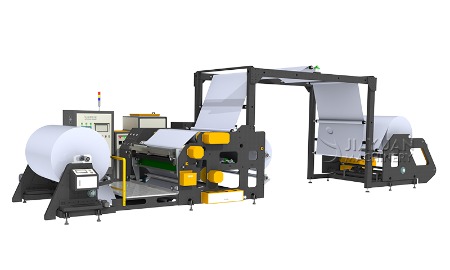
Adhesive coating machine
PSA coating machines can process various adhesive chemistries including hot melt, solvent-based, and water-based pressure sensitive adhesives. Hot melt PSA coating is the most prevalent method due to its high speed, zero VOC emissions, and energy efficiency. In hot melt PSA coating, the adhesive (100% solids) is heated to a molten state (typically 140-180°C depending on the polymer type) and applied via slot die, roll, or spray coating. Slot die coating is increasingly dominant for PSA applications due to its superior precision, with thickness uniformity within ±1% and the ability to handle low-viscosity hot melts. The slot die consists of an internal manifold that distributes molten adhesive uniformly across the web width, with the lip gap precisely controlled to achieve the desired coat weight.
A typical PSA coating machine for hot melt applications includes several key components: a liner unwind station, a corona treater (optional for surface activation), a slot die coater, a cooling drum, a laminating station for face stock lamination, and a rewind station. Temperature control across the die must be maintained within ±0.5°C to avoid viscosity variations that would affect coat weight uniformity. The backup roll is typically chrome-plated steel with a release finish to prevent adhesive sticking. A vacuum box upstream of the die helps remove the air boundary layer, preventing air entrainment that would cause coating defects. Closed-loop coat weight control using beta or X-ray gauges with feedback to the pump drive maintains weight accuracy within ±1.5% over extended production runs.
PSA coating machines must address several operational challenges to ensure product quality. Liner handling is critical because silicone-coated liners are sensitive to tension, and excessive tension can cause stretching, telescoping, or baggy edges. Adhesive filtration (150-200 mesh) is essential to remove gels that would cause defects in the thin adhesive layer (20-30 μm thick). The melt tank should have a small residence time to prevent degradation of thermally sensitive SBC-based PSAs. Common coating defects include "orange peel" (rough surface) caused by excessive viscosity, "stringing" at edges due to improper die adjustment, "missing coating" from air entrainment, and "gauge bands" from pump pulsation. Advanced PSA coating machines incorporate automatic die lip adjustment, edge air jets, and precision temperature control systems to minimize these defects and maintain consistent product quality.