release liner coating
Release liner coating is the application of a release material, typically silicone, onto a paper or film substrate to create a liner that allows a pressure-sensitive adhesive (PSA) to be stored and handled without premature sticking. The release liner is an essential component of self-adhesive labels, tapes, medical dressings, and many other PSA products. This article provides a comprehensive technical overview of release liner coating technologies, materials, application methods, process control, and quality considerations.
Release liners serve as temporary carriers for PSAs. They protect the adhesive from contamination and allow easy release when the label or tape is applied. The release coating must have a controlled release force: low enough to allow easy peeling, but high enough to prevent premature detachment during converting and shipping. The most common release coatings are silicone-based, but non-silicone coatings (e.g., fluoropolymers, polyolefins, or chromium complexes) are also used for specialty applications where silicone transfer is undesirable. The liner substrate is typically supercalendered glassine paper, poly-coated paper, or PET film. The coating is applied at very low coat weights: for silicone, typically 0.5-2 gsm (dry), which is among the thinnest industrial coatings. The coating must be uniform and defect-free, as any pinhole or missing area will cause the PSA to stick to the liner (adhesion failure). Release liner coating machines are high-precision roll-to-roll systems, often using gravure, roll, or slot die coating, followed by a curing oven (for thermal curing of silicone) or UV curing. Line speeds range from 100 to 400 m/min, with widths up to 2000 mm.
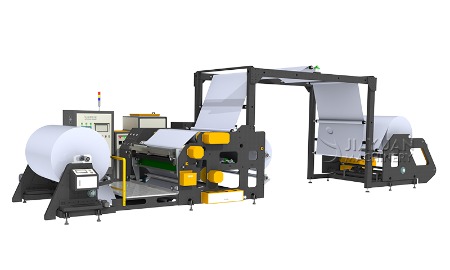
Adhesive coating machine
Silicone release coatings are the industry standard. They are based on polydimethylsiloxane (PDMS) polymers, formulated with crosslinkers, catalysts, and adhesion promoters. Silicone coatings are applied as solvent-based, solventless (100% solids), or emulsion (water-based). Solventless silicones are preferred for environmental and economic reasons, as they eliminate VOC emissions and drying, but they require precise mixing and application. They are cured via addition reaction (platinum-catalyzed) at elevated temperatures (100-160°C) or via UV-cationic or UV-free radical mechanisms. Thermal curing ovens are the most common, with multiple zones to ensure complete crosslinking. The coat weight must be extremely uniform; variations of ±0.2 gsm can cause significant differences in release force. Gravure coating is the most popular method for applying silicone due to its ability to apply very thin, uniform layers; the engraved cell volume and the doctor blade pressure determine the wet coat weight. Roll coating (reverse roll or offset) is also used, especially for higher viscosities. Slot die coating is emerging for precision applications, particularly for solventless silicones. The coating must be applied to a clean, smooth liner substrate; surface defects (unevenness) will show through and affect release.
The curing process for silicone is critical to achieve the desired release properties. For thermal curing, the coated liner passes through a multi-zone oven with temperatures rising from 80°C to 160°C. The residence time must be sufficient for complete crosslinking; undercuring results in high release force (tight release) and possible transfer of uncured silicone to the PSA (silicone migration), which reduces PSA adhesion. Overcuring can make the coating brittle and cause dusting. Inline sensors (e.g., Fourier-transform infrared spectroscopy) can monitor the degree of cure. For UV-curable silicones, the liner passes under high-intensity UV lamps (mercury or LED) with a specific dose (mJ/cm²) to initiate polymerization; this offers lower energy consumption and no thermal substrate stress. After curing, the liner may be cooled and then rewound with interleaving paper or film to prevent surface damage. Some lines include a corona treater for the liner before coating to improve silicone adhesion to certain substrates. The release force is measured by applying a standard PSA tape to the coated liner and measuring the peel force; the value is specified (typically 5-50 g/inch for standard release, and 50-150 g/inch for heavy release). The release force must be consistent across the roll and within the product specification.
Process control in release liner coating is demanding due to the low coat weight and the need for absolute defect-free coating. The coating weight is controlled by adjusting the gravure roll speed, the doctor blade force, and the adhesive viscosity. Online gauges (beta or X-ray) measure the total mass per area, but because the coating is so thin, the substrate weight variation can mask the coating weight; therefore, precise substrate weight control and differential gauging (measuring before and after coating) are often used. Tension control is critical to prevent stretching of the thin paper or film liner. The curing oven temperature and airflow must be uniform across the width to avoid differences in cure degree. Inline vision systems detect pinholes, streaks, and coating misses using transmitted or reflected light. The liner surface is inspected for contamination (dust, fibers) that would cause release spots. All process parameters are logged for traceability. The final rolls are tested for release force, silicone transfer (by surface analysis), and resistance to aging (heat and humidity). Quality documentation is essential for regulatory compliance, especially in medical and food applications where silicone contamination must be controlled.
Applications of release liner coating are vast. In self-adhesive labels, the liner is the backing that carries the face material and PSA. In tape manufacturing, release liners are used for double-sided tapes and transfer tapes. In medical dressings, liners provide sterile protection and easy application. In graphic arts, liners are used for vinyl decals and sign films. The trend in release liner technology is toward thinner and more sustainable liners (recyclable paper and films) and toward silicone-free release coatings (for applications where silicone transfer is detrimental, such as in electronics or certain medical products). Non-silicone releases often use polyvinyl carbamate, chromium complexes, or other polymers, but they generally have higher release forces and less durability. Additionally, the industry is moving toward solventless silicone systems to reduce environmental footprint, and toward UV-curing to save energy. Inline coating and curing systems are becoming more automated with real-time release force monitoring and feedback control. In summary, release liner coating is a highly specialized, precision process that is vital to the performance of all pressure-sensitive adhesive products, requiring meticulous control of coat weight, curing, and surface quality to ensure reliable and consistent release properties.