reverse roll coater
A reverse roll coater is a sophisticated industrial coating machine that uses a set of counter-rotating rolls to apply and precisely meter a coating material onto a substrate. The defining feature of this technology is that the metering roll rotates in the opposite direction to the applicator roll, creating a high-shearing action that yields exceptional coat weight uniformity and surface smoothness. This method is widely used for high-precision adhesive applications, particularly for solvent-based and water-based systems, where precise thickness control is critical. This article provides a comprehensive technical overview of reverse roll coater design, working principles, process parameters, and applications.
The reverse roll coater typically consists of three to four rolls arranged in a specific configuration. In a three-roll version, the arrangement includes a metering roll, an applicator roll, and a backup roll. The coating fluid is fed into the nip between the metering roll and applicator roll. The metering roll rotates in the opposite direction to the applicator roll, causing the fluid to be sheared in the nip. This shearing action meters the coating to a precise film thickness on the applicator roll. The applicator roll then transfers this film to the substrate as it passes between the applicator roll and the backup roll. The reverse rotation creates a wiping action that removes excess material, resulting in a highly uniform coating. In a four-roll configuration, an additional nip roll is added to further refine the coating or to separate the metering and transfer functions.
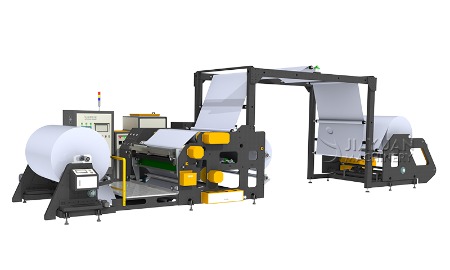
Adhesive coating machine
Reverse roll coaters offer several significant advantages. The shearing action in the metering nip allows for precise coat weight control, with thickness variation typically within ±1-2%, comparable to slot die coating. The reverse rotation provides excellent surface finish, eliminating streaks and producing a smooth, glossy coating. The coater can handle a wide range of viscosities (from 50 to 50,000 cP) and can achieve very thin coatings (0.5-5 gsm) with high precision. The open design allows easy cleaning and quick changeover between different adhesives, making it suitable for short-run and high-mix production. Additionally, the reverse roll coater can operate at high speeds (up to 300 m/min) and can coat both porous and non-porous substrates with equal effectiveness.
However, reverse roll coaters also have limitations. The complex roll arrangement requires precise mechanical setup and regular maintenance to maintain nip uniformity. The shearing action can cause heat generation and may degrade shear-sensitive adhesives. The coating process is sensitive to fluid rheology, and any viscosity changes (e.g., due to temperature or solvent evaporation) directly affect coat weight. The open coating bead can lead to solvent evaporation and skin formation if not properly managed. The rolls must be manufactured to tight tolerances (runout < 5 μm) and require periodic regrinding to maintain surface finish. The capital cost of a reverse roll coater is generally higher than simpler roll coaters, but the superior precision justifies the investment for high-value applications.
Key process parameters in reverse roll coating include the gap between the metering and applicator rolls, the speed ratio between these two rolls, and the nip pressure between the applicator and backup rolls. The metering gap is typically set at 10-200 μm and is the primary control for coat weight. The speed ratio (metering roll speed divided by applicator roll speed) strongly influences the film thickness; a ratio below 1 produces thicker coatings, while ratios above 1 produce thinner coatings due to increased shear. The nip pressure between applicator and backup rolls controls the transfer efficiency and substrate penetration, with typical pressures ranging from 1 to 10 bar. The roll temperatures must be controlled to maintain consistent viscosity, especially for hot melt adhesives where heated rolls are required. Modern reverse roll coaters incorporate automated gap control, real-time thickness measurement, and PLC-based process management.
Reverse roll coaters are extensively used in the adhesive industry for producing high-quality pressure-sensitive adhesive tapes, labels, and laminating films where precise, thin adhesive layers are required. They are particularly suited for solvent-based acrylic adhesives used in high-performance tapes (e.g., automotive, aerospace) due to their ability to achieve low coat weights with excellent uniformity. The packaging industry uses reverse roll coaters for applying primers, varnishes, and barrier coatings on flexible films. Other applications include medical products (such as transdermal patches and wound dressings), optical films, and specialty papers. The technology continues to evolve with advancements in roll materials, bearing technology, and control systems, maintaining its position as a premier precision coating method for demanding adhesive applications.