rewind tension
Rewind tension is the longitudinal force applied to the coated web as it is wound onto the finished roll at the end of the coating line. This tension is critical for achieving rewind rolls with the correct density, hardness, and stability, which are essential for subsequent converting operations and customer satisfaction. This article provides a comprehensive technical overview of rewind tension, including its principles, control strategies, effects on roll quality, and common issues.
The rewind station is the final section of the coating line, where the coated and dried (or cured) web is wound into rolls for storage, shipment, or further processing. Rewind tension must be carefully controlled to produce rolls that are tight enough to prevent telescoping and loose layers, but not so tight that they cause blocking (adhesive sticking to the back of the web) or crushing. The tension is typically generated by a driven rewind motor that pulls the web and winds it onto the core. As the roll diameter increases, the torque required to maintain a constant tension increases (torque = tension × radius). The control system must increase the motor torque in proportion to the roll diameter to keep tension constant. Diameter can be measured by ultrasonic sensors, by counting revolutions, or by calculating based on line speed and roll speed.
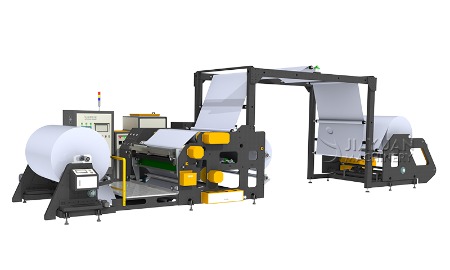
Adhesive coating machine
Constant tension winding is the simplest and most common method, but it can lead to problems for sensitive products. As the roll grows, the weight of the outer layers compresses the inner layers, increasing the interlayer pressure. Under constant tension, the pressure at the core becomes very high, which can cause core crushing or adhesive flow. Therefore, many coating lines use tapered tension or programmed tension profiles, where the tension is gradually reduced as the roll diameter increases. This reduces the pressure on the inner layers and produces a more uniformly hard roll. The taper is typically expressed as a percentage reduction in tension from the beginning to the end of the roll; common tapers range from 20-50% depending on the adhesive and substrate. Some advanced systems use a winding model (e.g., the Dwell or Yoder model) to calculate the optimal tension profile that minimizes internal stresses and ensures roll stability. The actual tension profile is often determined empirically through trial runs and is specific to each product.
Rewind tension directly affects the hardness and density of the finished roll, which are measured by durometer or roll hardness testers. A roll that is too soft (low tension) will have layers that slip against each other, causing telescoping (where layers slide sideways) and edge damage. Soft rolls are also difficult to handle and may unwind unpredictably. A roll that is too hard (high tension) can cause the adhesive to squeeze out at the edges or the core to collapse; it also increases the risk of blocking, where the adhesive sticks to the backing of the next layer, preventing unwinding. The optimal roll hardness depends on the adhesive tack, substrate thickness, and winding speed. For high-tack adhesives, lower winding tensions are used to prevent blocking; for low-tack adhesives, higher tensions can be used. Additionally, the rewind tension must be coordinated with the line speed; during speed changes, the tension control must adjust quickly to avoid loose wraps or overtension. A common issue is the "star" or "telescoping" pattern caused by uneven tension distribution across the web width, often due to misaligned rewind rolls or incorrect lay-on roller pressure.
Modern rewind stations include several features to improve roll quality. The lay-on roller (a driven or idler roll that presses against the winding roll) applies a controlled nip pressure that helps expel air between layers and ensures a snug wind. The pressure of the lay-on roller is often regulated by pneumatic or hydraulic cylinders, and it may be profiled across the width to compensate for uneven roll stiffness. Some rewinders also have a spreader roll (e.g., a bowed roll) to spread the web and prevent wrinkles during winding. Automatic turret rewinders allow continuous winding by pre-rotating a new core and transferring the web without stopping the line; the tension control must handle the transfer transient smoothly. Quality inspection systems (e.g., cameras or lasers) at the rewind can detect defects before the roll is complete, allowing graded product segregation.
Troubleshooting rewind tension issues is a key skill for line operators. Common problems include loose starting wraps (caused by insufficient initial tension), telescoping (usually due to low tension or misalignment), and core crushing (due to excessive tension or a too-hard roll). If the roll has "telescoping," the rewind tension is often increased or the taper adjusted. If blocking occurs, the tension is reduced, or the web may be cooled before winding. The rewind tension setpoint is typically specified on the product recipe and may vary with the roll diameter. In summary, rewind tension is not a static parameter but a dynamic, profile-controlled variable that requires careful optimization to produce defect-free, stable rolls that meet customer requirements and perform well in downstream operations.