roll coating machine
A roll coating machine is a versatile and widely used industrial system that applies a liquid or semi-solid coating material onto a substrate by passing it through one or more rotating rolls. These machines are fundamental to the production of coated paper, film, foil, textiles, and various adhesive products, offering simplicity, high speed, and adaptability to a wide range of coating viscosities and coat weights. This comprehensive article covers the working principles, major types, process parameters, application areas, and selection criteria for roll coating machines.
The fundamental principle of a roll coating machine involves transferring a coating fluid from a reservoir to a substrate through a series of rotating rolls. In its simplest configuration, a single roll picks up the coating from a pan and transfers it directly to the substrate as it passes between the applicator roll and a backup roll. More sophisticated designs incorporate multiple rolls to meter the coating thickness precisely before application. The coating thickness is determined by the gap between rolls, the roll speed ratio, and the fluid rheology. Roll coaters can handle a broad viscosity range from low-viscosity solutions (50 cP) to high-viscosity pastes (50,000 cP) and can achieve coat weights from 1 to 500 gsm, making them one of the most flexible coating technologies available.
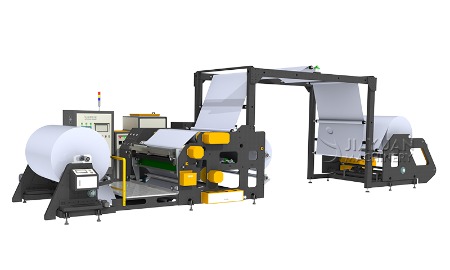
Adhesive coating machine
Roll coating machines are classified into several major types based on the roll arrangement and coating application method. Two-roll coaters are the simplest, with an applicator roll and a backup roll, suitable for low-precision applications. Three-roll coaters add a metering roll that controls the amount of adhesive on the applicator roll, improving coat weight uniformity. Four-roll coaters (often called reverse roll coaters) provide the highest precision, with the metering roll rotating in the opposite direction to the applicator roll, creating a shearing action that precisely meters the coating. Other specialized types include kiss coaters where the substrate lightly touches the applicator roll, and gravure coaters which are a subset of roll coating using an engraved cylinder. Each type offers distinct advantages in terms of precision, speed capability, and adhesive viscosity range.
Key process parameters in roll coating include roll speed, nip pressure, roll gap, and the relative speed ratios between rolls. The nip pressure between the applicator and backup rolls determines the coating penetration into porous substrates and the final coat weight. The roll gap, typically adjustable within 10-500 μm, controls the coating thickness for metering systems. For reverse roll coating, the speed ratio between the metering roll and the applicator roll significantly affects coating weight and surface quality. Temperature control is critical for hot melt adhesives, requiring heated rolls to maintain viscosity. Modern roll coating machines incorporate servo-driven roll motors, precision gap adjustment mechanisms, and closed-loop coat weight control using beta or X-ray gauges to ensure consistent product quality across long production runs.
Roll coating machines find extensive applications across multiple industries. In the adhesive industry, they are used to apply solvent-based, water-based, and hot melt adhesives onto tapes, labels, and laminating films. The packaging sector uses roll coaters for applying varnishes, primers, and heat-seal coatings on flexible packaging materials. In the converting industry, roll coaters apply release coatings on silicone liners, pressure-sensitive adhesives on labels, and protective coatings on films. Other applications include textile finishing (applying sizing, softeners, and flame retardants), paper coating (applying clay, latex, and pigmented coatings), and specialty applications such as optical film coatings. The selection of a roll coating machine depends on factors such as required coating accuracy, production speed, adhesive type, substrate properties, and available floor space. Roll coaters remain a cost-effective and reliable choice for many coating operations, with ongoing advancements in roll design, automation, and control systems enhancing their performance and versatility.