roll to roll coating
Roll to roll (R2R) coating is a continuous manufacturing process in which a flexible substrate, unwound from a supply roll, passes through a series of coating, drying/curing, and finishing stations, and is then rewound into a finished roll. R2R coating is the dominant production method for adhesive tapes, labels, flexible packaging, medical films, and many other web-based products because it offers high throughput, excellent uniformity, and cost efficiency. This article provides a comprehensive technical overview of roll to roll coating, including its basic principles, key components, process advantages, common applications, and technological trends.
The fundamental architecture of a roll to roll coating line consists of an unwind station, a web handling section with tension control and edge guiding, one or more coating stations (e.g., slot die, gravure, comma blade), a drying or curing section (oven, UV, or chill rolls), optional processing stations (lamination, slitting, inspection), and a rewind station with turret capabilities. The substrate, typically a film, paper, foil, or nonwoven, moves continuously through the line at speeds ranging from 10 to over 600 m/min, depending on the process and product. The key advantage of R2R processing is that it is continuous, meaning that once the line is started, it can run for hours or even days without interruption, producing large volumes of coated material with consistent quality. This continuity minimizes start-up and stop waste, and enables high utilization of capital equipment.
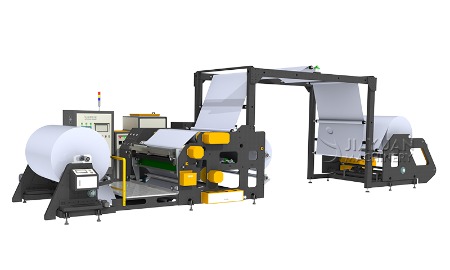
Adhesive coating machine
Web handling is the backbone of any R2R coating line. The substrate must be transported with precise tension control at every stage to avoid stretching, wrinkling, or breaking. Tension is typically regulated using a combination of load cells, dancer rolls, and driven rolls in a closed-loop control system. Edge guiding devices (photoelectric or ultrasonic) keep the web aligned to the coating head and other stations. The web path must be designed with adequate wrap angles on rolls to prevent slippage. For delicate substrates like thin films (e.g., 12 µm PET), tension must be kept low (e.g., 0.5-1 N/cm width) to avoid elongation. For paper, higher tension (2-5 N/cm) may be used. The web is often cleaned with ionizing air or vacuum before coating to remove dust and static. Proper web handling is critical for achieving the high coat weight uniformity and defect-free products that R2R coating is known for.
The coating station in an R2R line is selected based on the adhesive type, required coat weight, and precision. Slot die coating is the preferred choice for high-precision hot melt PSAs, offering thickness uniformity within ±1% and coat weight variation of ±1-2%. Gravure coating is used for very thin layers (e.g., silicone release coatings). Comma blade coating is widely used for water-based and solvent-based adhesives on paper and film. Roll coating (including reverse roll) is versatile for medium to high viscosities. The coating station is integrated with the drying or curing system, which must match the line speed. For solvent-based and water-based adhesives, the drying oven must be long enough to evaporate the carrier at maximum speed; for hot melt, chill rolls cool and solidify the adhesive. The line may also include a corona treater for surface activation, a laminator for multi-layer construction, and a slitter for converting the wide web into multiple rolls. The entire line is controlled by a PLC with HMI, often with recipe management for different products.
Roll to roll coating offers significant advantages over batch or sheet-fed processes. It provides exceptional coating uniformity because the substrate moves at constant speed under a steady coating bead. Material utilization is high because scrap is limited to startup, splices, and the ends of rolls. The process is highly scalable; wider webs and higher speeds increase output with relatively small increases in capital cost. R2R coating also enables the production of very long lengths (up to 10,000 meters or more) in a single roll, which is essential for high-volume converting operations. However, R2R coating requires significant capital investment, complex setup, and skilled operators. Changeovers between products can be time-consuming, although modern designs with quick-change modules reduce downtime. The trend in R2R coating is toward wider webs (up to 2,000 mm), higher speeds, and greater automation, including inline inspection and closed-loop control. Additionally, R2R coating is expanding into new applications such as flexible electronics, battery electrodes, and printed sensors, where precision and cleanliness are paramount. In summary, roll to roll coating is the foundation of modern adhesive manufacturing, enabling high-quality, cost-effective production of a vast array of coated products essential for daily life.