slot die
A slot die is a precision-engineered component used in slot die coating machines to apply a uniform layer of fluid onto a moving substrate. It consists of a metal block with an internal manifold that distributes coating material across the web width and a narrow slot (exit gap) through which the fluid is extruded onto the substrate. Slot dies are widely regarded as the most precise coating method available, achieving thickness uniformity within ±1% and coat weight variation of ±1-2%. This article provides a comprehensive technical overview of slot die design, working principles, process parameters, and application in adhesive coating.
The fundamental principle of a slot die is based on pressure-driven flow through a precision slot. Coating fluid is pumped into the die inlet, enters the internal manifold (typically a coat-hanger or T-shaped design), and is distributed uniformly across the full width. The fluid then passes through a narrow slot formed by two precision-ground lips, emerging as a continuous film that is deposited onto the substrate passing beneath the die. The coating thickness is determined by the ratio of fluid flow rate (controlled by a gear pump) to line speed, independent of the die gap (within limits). The slot die operates in a close proximity mode, with the die lips positioned 0.1-1.0 mm above the substrate, forming a stable fluid bead in the gap. This non-contact operation eliminates wear on the die and substrate, enabling high-speed, high-precision coating.
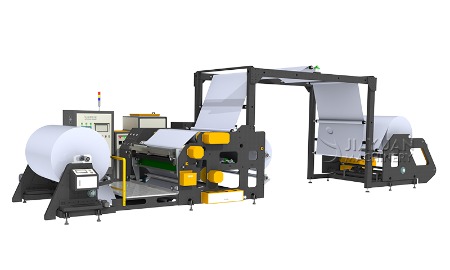
Adhesive coating machine
Slot die design is critical to achieving uniform coating. The internal manifold must ensure that the pressure at every point along the slot is equal, so that the flow rate per unit width is constant. The most common manifold geometry is the coat-hanger (or "T-die") design, where the cross-sectional area decreases exponentially from the center to the edges to compensate for fluid extraction along the slot. The pressure drop across the slot (from manifold to exit) is typically 1-10 bar, depending on fluid viscosity and flow rate. The slot length (L) is the distance from the manifold to the lip exit, typically 10-50 mm, and its ratio to the slot gap (H) determines the pressure drop and shear rate. The lip flatness and straightness are ground to within 0.2-0.5 μm per 100 mm to achieve uniform gap. The die material is usually tool steel or stainless steel, with hardened surfaces for wear resistance. For hot melt adhesives, the die is heated (typically 140-200°C) using cartridge heaters or oil circulation, with temperature uniformity across the width within ±0.5°C.
Key process parameters in slot die coating include flow rate, line speed, die gap (lip-to-substrate distance), and temperature. The flow rate is set by a gear pump or other positive displacement pump, with accuracy typically within ±0.5%. The line speed determines the coating thickness for a given flow rate; the relationship is linear: coat weight (gsm) = (flow rate per unit width) / (line speed) × density. The die gap affects the stability of the coating bead; a smaller gap increases shear and allows higher speeds but requires precise positioning. The optimal gap is typically 0.2-0.5 mm for low-viscosity fluids and 0.5-1.0 mm for high-viscosity fluids. Temperature control is essential for hot melts to maintain viscosity within the stable coating window; viscosity variations of even 5% can cause coat weight changes. Additionally, the die face must be perfectly parallel to the backup roll; any misalignment causes cross-web coat weight variations. Modern slot dies incorporate thermal actuators (heated bolts) that allow fine adjustment of the lip gap at multiple points across the width, enabling real-time profile correction based on coat weight gauge feedback.
Slot dies offer numerous advantages over other coating methods. The closed system minimizes solvent evaporation and contamination, making it environmentally friendly and reducing material waste. The precision volumetric metering provides exceptional coat weight control, enabling consistent product quality even at high speeds (up to 600 m/min). Slot dies can apply a wide range of coat weights (2-200 gsm) and handle viscosities from 100 to 50,000 cP. They can also apply multiple stripes or patterned coatings by modifying the die lip geometry (e.g., creating slots with interruptions). The non-contact operation prevents substrate damage and reduces maintenance. However, slot dies also have limitations: they are expensive to manufacture and require precise alignment and temperature control; they are sensitive to fluid cleanliness (particles can clog the narrow slot); and they have limited flexibility for very thin coatings (<1 gsm) or very high viscosities (>50,000 cP) without specialized designs.
Slot dies are the preferred coating method for high-value adhesive applications, especially pressure-sensitive adhesives (PSAs) in tapes, labels, and medical products. The precision and speed of slot die coating make it ideal for hot melt PSAs, which dominate the market due to their zero-VOC, high-speed processing. Slot dies are also used for solvent-based and water-based adhesives where superior uniformity is required, such as optical films and battery electrodes. In the medical field, slot dies coat transdermal patches and wound dressings with precise drug or adhesive layers. The technology is also applied in silicone release coating, where ultra-thin, uniform layers are essential. Ongoing advancements in slot die design include modular, quick-change dies for faster product changeovers; improved materials for corrosion resistance and wear; and integration with advanced process control systems using machine learning for predictive adjustment. The slot die remains the gold standard for precision coating, and its importance continues to grow as industries demand tighter tolerances and higher productivity.