solvent adhesive coating machine
A solvent adhesive coating machine is an industrial system that applies adhesives dissolved in organic solvents onto substrates, with the solvent subsequently evaporated in drying ovens to leave a solid adhesive layer. These machines are essential for producing high-performance adhesive products where hot melt or water-based alternatives cannot meet specific requirements. This article provides a detailed technical overview of solvent adhesive coating machines, including working principles, process parameters, advantages, limitations, and application areas.
The fundamental operating principle of a solvent adhesive coating machine involves dissolving the adhesive polymer in an organic solvent (such as toluene, acetone, or ethyl acetate) to reduce viscosity, applying this solution onto a moving substrate, and then evaporating the solvent in a drying oven to leave behind the solid adhesive coating. The coating is typically applied using gravure or roll coaters, with the adhesive solids content typically ranging from 20-50%. After coating, the substrate passes through a long drying tunnel (typically 30-60 meters) with multiple temperature zones for controlled solvent evaporation and recovery. The solvent is either vented (with appropriate environmental controls) or recovered for reuse, adding complexity and cost to the system.
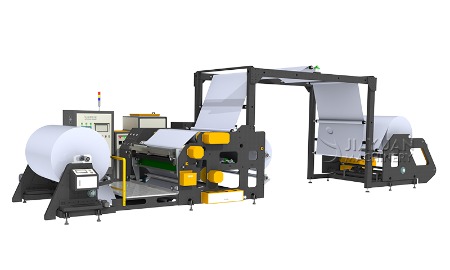
Adhesive coating machine
Solvent adhesive coating machines offer several distinct advantages that make them indispensable for certain applications. They can produce very thin dry coatings (0.5-2 gsm) that are difficult to achieve with hot melt systems. The solvent carrier allows the application of adhesives that cannot be melted or dispersed in water, including many high-performance rubber-based and acrylic adhesives. Solvent-based systems operate at ambient to moderate temperatures (typically up to 80°C), making them suitable for heat-sensitive substrates such as thin polyolefin films that would distort at hot melt temperatures. The solvent also provides excellent wetting on difficult substrates and allows for the incorporation of additives that might be incompatible with water-based or hot melt systems. These capabilities make solvent coating the preferred choice for certain high-value products such as optical films, electronic tapes, and specialty industrial materials.
However, solvent adhesive coating machines also have significant limitations. The drying process consumes enormous amounts of energy—a 1600mm wide solvent coater running at 150 m/min with a drying oven consumes approximately 500-800 kW of energy, compared to only 30-60 kW for a comparable hot melt line. This translates to annual energy costs of $400,000-640,000 for solvent-based systems versus $40,000-80,000 for hot melt. Solvent-based machines also emit volatile organic compounds (VOCs) unless equipped with expensive thermal oxidizers or solvent recovery systems, which add 30-50% to the capital cost. The solvent evaporation process can cause uneven solid deposition (the "coffee ring effect"), leading to higher coat weight variation (±5-10%) compared to hot melt slot die coating. Additionally, solvent-based adhesives contain flammable solvents, requiring explosion-proof equipment and strict safety protocols.
A typical solvent adhesive coating machine includes several key components: a mixing and supply system where the adhesive is prepared and pumped to the coating head, a coating station (usually gravure or roll coater), a drying oven with multiple temperature zones and air handling systems, and unwind/rewind stations with tension control. The drying oven is the most critical and expensive component, requiring careful design to ensure complete solvent removal without damaging the substrate or causing coating defects. For solvent-based PSAs, the coating is typically applied by reverse gravure or roll coating, with the adhesive solids content and coating speed carefully matched to the drying capacity. Many jurisdictions are phasing out solvent-based coating due to air quality regulations, making hot melt the only viable option for new installations in regulated areas. However, for applications requiring ultra-thin coatings or adhesives that cannot be processed by other methods, solvent adhesive coating machines remain an essential technology.