spray coating machine
A spray coating machine is an industrial system that applies a liquid coating material onto a substrate through a spray nozzle system that atomizes the fluid into fine droplets, which are then directed onto the substrate surface. This non-contact method is widely used for applying adhesives, varnishes, and various functional coatings where uniformity, precise pattern control, and minimal substrate stress are required. This article provides a comprehensive overview of spray coating machine technology, including working principles, nozzle types, process parameters, advantages, and application areas.
The fundamental principle of a spray coating machine involves feeding a liquid coating (such as a solvent-based or water-based adhesive) to a spray nozzle where it is atomized into a mist of fine droplets. The atomization is typically achieved by hydraulic pressure, compressed air, or ultrasonic vibration. The spray pattern is then directed onto the substrate as it passes through the coating zone. Unlike contact coating methods (e.g., roll or gravure), spray coating does not physically touch the substrate, eliminating the risk of web breakage or surface damage. The coating thickness is controlled by adjusting the liquid flow rate, line speed, and the number of spray passes or multiple nozzle arrays. Spray coaters can apply coatings from very thin (0.5 gsm) to relatively heavy (50 gsm) depending on the nozzle configuration and process conditions.
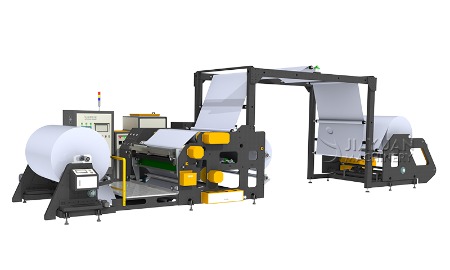
Adhesive coating machine
Spray coating machines employ several nozzle technologies to achieve different atomization and spray patterns. Airless spray nozzles use high hydraulic pressure (up to 300 bar) to force fluid through a small orifice, creating a high-velocity spray without compressed air, suitable for high-viscosity fluids and heavy coatings. Air-assisted spray nozzles combine hydraulic pressure with compressed air to produce finer droplet sizes and better pattern control, ideal for medium-viscosity adhesives. Rotary atomizers use a high-speed spinning disk or bell that centrifugally atomizes the fluid, producing extremely fine droplets with narrow size distribution, commonly used for high-precision coatings on automotive and electronic products. Ultrasonic nozzles use high-frequency vibrations to atomize the fluid into a very fine, monodisperse spray, suitable for delicate substrates and low-void coatings. The choice of nozzle technology depends on the required coating uniformity, droplet size, viscosity, and production speed.
Key process parameters in spray coating include spray pressure, liquid flow rate, nozzle-to-substrate distance, and line speed. The spray pressure controls droplet size and spray velocity, with higher pressures producing finer droplets but also increasing overspray. The liquid flow rate determines the total coating output, and must be precisely matched to line speed to achieve the desired coat weight. Nozzle-to-substrate distance typically ranges from 150 to 500 mm; closer distances produce narrower, more intense spray patterns but may cause puddling, while greater distances increase overspray and material waste. The spray pattern must be carefully overlapped to achieve uniform coverage, typically requiring 30-50% pattern overlap in multi-nozzle systems. Environmental conditions such as temperature, humidity, and airflow in the coating zone affect solvent evaporation and droplet behavior, requiring careful control to avoid defects like orange peel or dry spray.
Spray coating machines offer several significant advantages. The non-contact nature allows coating of fragile, uneven, or three-dimensional substrates that cannot be coated by contact methods. Spray coating enables precise pattern application, including edge-only coating or selective area coating, reducing material waste. The method can achieve excellent coating uniformity with proper nozzle and process design, and can handle a wide range of coating viscosities from thin solutions to thick pastes. Spray coaters are also highly flexible, allowing quick changeovers between different coatings and product configurations. However, spray coating has drawbacks: low transfer efficiency (typically 40-70% depending on nozzle type), high overspray losses, and the need for sophisticated ventilation and solvent recovery systems for solvent-based coatings. Spray coating is also generally slower than roll coating, limiting line speeds to 30-100 m/min.
Spray coating machines are used in numerous adhesive application areas. In the label industry, spray coaters apply water-based adhesives to linerless labels and specialty labels. In nonwoven hygiene products, spray coating applies construction adhesives for diapers and feminine care products, achieving low coat weights and breathable bonds. The packaging industry uses spray coating for applying cold-seal adhesives on film and foil, as well as for applying varnishes and primers. Medical applications include spray coating of wound dressings and transdermal patches where precise, low-coat-weight adhesive deposition is required. Other applications include automotive interior components, textile coating, and electronic device assembly. Modern spray coating machines incorporate automated nozzle cleaning, closed-loop flow control, and vision systems for pattern verification, improving reliability and reducing waste in production environments.