streak free coating
Streak free coating refers to the achievement of a smooth, continuous, and uniform adhesive layer without any linear defects or irregularities that appear as lines or bands in the machine direction. Streaks are among the most common and visible coating defects, degrading product appearance, adhesion performance, and converting efficiency. This article provides a comprehensive technical overview of streak formation mechanisms, root causes, detection methods, and systematic approaches to achieving and maintaining streak free coating in adhesive manufacturing processes.
Streaks in adhesive coating manifest as longitudinal lines of varying coat weight, often appearing as light (thin) or dark (thick) bands that run parallel to the web direction. They can be caused by mechanical damage, flow disturbances, contamination, or improper process settings. Streaks are particularly problematic for transparent tapes, labels, and optical films where visual quality is paramount, but they also affect functional performance by creating weak lines that can fail during peeling or die-cutting. Achieving streak free coating requires meticulous control over the coating head condition, fluid rheology, substrate cleanliness, and operating parameters. The challenge is amplified at higher line speeds and with more viscous or filler-containing adhesives, where small imperfections are magnified. Therefore, streak prevention is a primary objective in coating line design, maintenance, and daily operation.
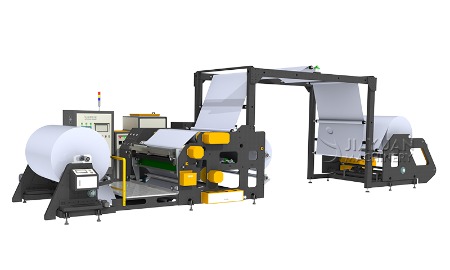
Adhesive coating machine
The root causes of streaks can be categorized into mechanical, rheological, and contamination sources. Mechanical causes include scratches or nicks on the die lip, doctor blade, or roll surfaces, which create localized flow variations. A scratch of even 10-20 µm depth can produce a visible streak by disrupting the uniform film splitting or metering. Roll eccentricity or bearing play causes cyclic thickness variations that appear as periodic streaks. Rheological causes include viscosity non-uniformities due to temperature gradients across the die, which alter flow distribution and create heavy or light streaks. In slot die coating, an uneven manifold pressure or a misaligned lip gap leads to cross-web flow variations that manifest as streaks. Contamination sources include gels, undissolved polymer particles, or foreign debris that obstruct the die slot or get embedded in the coating, creating drag lines or shadow streaks. Air entrainment can also cause intermittent streaks where air bubbles are trapped, leaving a trail of pinholes or thin lines. Identifying the specific cause often requires systematic investigation using magnified visual inspection, profile measurements, and process data correlation.
Detection and characterization of streaks are performed using online and offline methods. Online machine vision systems with high-resolution line scan cameras capture images of the coated web under appropriate lighting (reflected or transmitted), and algorithms detect streaks based on contrast or intensity deviations from the background. The software classifies streaks by width, length, and optical density, and can trigger alarms or mark defects. Coat weight profile measurements using beta or X-ray gauges reveal streaks as localized deviations in the average coat weight; a streak with a thickness difference of 1-2 gsm from the target is typically detectable. Offline, streaks are examined under a microscope or with a surface profiler to measure their depth and morphology. Peel tests can reveal weak adhesion along streaks. Data from these measurements are used to map the defect frequency and distribution, aiding in root cause analysis. Regular monitoring and trending of streak incidence help identify degrading components (e.g., a gradually wearing die lip) before they cause significant scrap.
Preventive strategies for streak free coating cover equipment design, process control, and maintenance protocols. Equipment design should incorporate hardened, wear-resistant die lips and rolls with fine surface finishes (Ra < 0.2 µm for critical surfaces). Quick-change die heads and easy-access cleaning ports facilitate regular maintenance. Process control includes precise temperature uniformity across the die (within ±0.5°C) to avoid viscosity-driven streaks, and closed-loop gap control to maintain die lip parallelism. Filtration systems (e.g., 100-200 mesh screens or melt filters) remove gels and particles that cause contamination streaks. For roll coating, maintaining roll surface integrity through periodic grinding and chrome plating is essential. Operational best practices include purging the die after startups to remove any settled particles, using edge bead reduction technologies to prevent edge streaks, and optimizing line speed to stay within the stable coating window where streaks are minimized. Operators are trained to visually inspect the coating bead and the rewind roll for early signs of streaks, enabling immediate corrective actions such as cleaning the die lip or adjusting the gap. Statistical process control of streak defect rates helps track improvements and identify process drifts. Ultimately, streak free coating is an achievable goal through a combination of robust design, vigilant monitoring, and proactive maintenance, leading to higher yield, reduced waste, and superior product consistency.