textile coating machine
A textile coating machine is an industrial system designed to apply a continuous layer of polymeric or adhesive material onto woven, knitted, or nonwoven fabrics to impart functional properties such as waterproofing, flame retardancy, stiffness, breathability, or adhesive bonding. Textile coating is essential for producing outdoor gear, industrial fabrics, medical textiles, automotive upholstery, and protective clothing. This article provides a comprehensive technical overview of textile coating machine configurations, coating methods, adhesive types, process parameters, and quality control.
Textile coating machines operate on the principle of applying a liquid or paste coating onto a moving fabric web, followed by drying, curing, or solidification. The fabric is unwound from a roll, passed through a coating station (where the coating is applied), then through a drying/curing oven, and finally rewound. The coating can be applied to one or both sides of the fabric, and may be a full coverage or a patterned coating. Typical coating weights range from 5 to 200 gsm (dry), depending on the function. The line speed is generally lower than paper or film coating, typically 10-60 m/min, due to the thickness and the need for thorough drying. Web widths range from 500 to 3000 mm, accommodating various fabric widths. The coating station may include a knife-over-roll, knife-over-air, roller, or slot die applicator, depending on the coating viscosity and required precision. The drying oven can be a hot air convection oven, an infrared oven, or a combination, with temperatures up to 200°C to cure thermoset coatings.
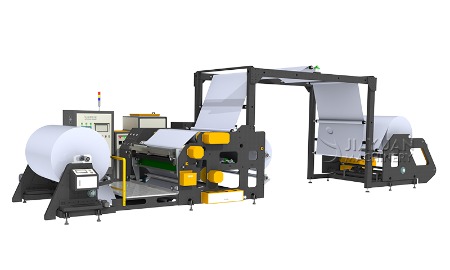
Adhesive coating machine
Several coating methods are used in textile coating machines, each suited to specific coating formulations and end-uses. Knife-over-roll coating is the most common: a sharp blade (doctor blade) is positioned over a support roll, and the coating paste is supplied in front of the blade; the gap between blade and fabric controls the coat weight. This method is versatile and can handle high-viscosity pastes (up to 50,000 cP). Knife-over-air (floating knife) is used for delicate fabrics where no backup roll is desired, allowing the fabric to float over the blade. Roll coating (including gravure) applies lower viscosity coatings and can achieve finer patterns. Slot die coating is gaining popularity for precise coating of specialty adhesives and functional coatings, offering excellent uniformity and minimal waste. Screen printing is used for patterned coatings, such as for breathable waterproof membranes. The choice depends on the coating rheology, target coat weight, and pattern requirement. For adhesive coatings, hot melt or water-based adhesives are often applied via knife or roll coaters, with subsequent cooling or drying. The coating head must be designed for easy cleaning, as textile coatings often contain fillers or thickeners that can clog.
Adhesives and coatings for textiles include acrylic polymers, polyurethanes, silicones, PVC plastisols, and natural rubber latex. These are often formulated with additives (flame retardants, UV stabilizers, antimicrobials) to achieve specific properties. Water-based dispersions are the most environmentally friendly, but require energy-intensive drying. Solvent-based coatings offer better water resistance and adhesion but emit VOCs. Hot melt adhesives are used for lamination and bonding in nonwoven applications. For adhesive lamination, the machine applies the adhesive onto one fabric and then laminates a second fabric under pressure, creating a multi-layer composite. The drying and curing conditions must be optimized: too high a temperature can degrade the fabric, too low leaves residual solvents or water that affect performance. The oven may have multiple zones with independent temperature and airflow control. Cooling sections after the oven set the coating and prevent blocking. Tension control is critical to avoid fabric distortion; fabric stretch can cause pattern misalignment and coat weight variation.
Process control in textile coating machines focuses on coat weight uniformity, coating adhesion, and fabric properties. Coat weight is monitored by online gauges (e.g., beta or NIR) and adjusted by blade gap or pump speed. The blade angle and pressure affect the coating profile. Fabric tension and speed must be synchronized to maintain consistent coat weight; any speed change requires proportional pump adjustment. The coating paste must be kept at constant viscosity by temperature control and regular mixing to prevent settlement. Inline inspection cameras detect coating skips, pinholes, and streaks. The coated fabric is tested for adhesion (peel and rub tests), water repellency, air permeability, and mechanical strength. The fabric substrate must be properly prepared (scoured, dried, and sometimes pre-heated) to ensure good adhesion. The machine settings and quality data are recorded for each batch to enable traceability and process optimization. Maintenance includes cleaning of blades and rolls, grinding of knife edges, and calibration of gauges and sensors.
Textile coating machines are used across a wide range of sectors. In outdoor apparel, they apply waterproof/breathable coatings (e.g., PU, PTFE) onto nylon or polyester for jackets and tents. In automotive, they coat upholstery fabrics with abrasion-resistant and flame-retardant coatings. In medical, they apply antimicrobial and skin-friendly coatings on wound dressings and surgical drapes. In industrial fabrics, they provide protective coatings for conveyor belts, tarpaulins, and geotextiles. In household furnishings, they apply stain-resistant and easy-care finishes. The trend toward sustainable textiles drives development of water-based, bio-based, and solvent-free coatings, as well as recyclable composites. Additionally, digital coating technologies (e.g., inkjet) are emerging for small-batch and customized applications. The textile coating machine is evolving with automation, better energy efficiency, and intelligent control systems that adapt to fabric variations. In summary, textile coating is a versatile and essential process for adding value and functionality to fabrics, and the coating machine must be carefully selected and operated to meet the demanding requirements of each application.