transfer adhesive coating
Transfer adhesive coating is a specialized manufacturing process in which a pressure-sensitive adhesive (PSA) is first applied onto a temporary carrier substrate—typically a silicone-coated release liner—and then subsequently transferred to the final substrate (facestock) in a separate lamination step. This two-stage method is the dominant production technique for self-adhesive labels, double-sided tapes, and many medical adhesive products, offering significant advantages in coating quality, process flexibility, and substrate compatibility. This article provides a comprehensive technical overview of transfer adhesive coating, including its working principles, equipment configuration, process parameters, and industrial applications.
The fundamental principle of transfer adhesive coating is the decoupling of the coating operation from the final substrate properties. In direct coating, the adhesive is applied directly onto the facestock, which may be a thin, delicate, or heat-sensitive material that is difficult to coat uniformly. In transfer coating, the adhesive is first coated onto a dimensionally stable release liner that has been pre-coated with a silicone release agent. The coated liner then passes through a drying oven (for solvent-based or water-based adhesives) or a cooling section (for hot melt adhesives) to solidify the adhesive layer. In a subsequent lamination step, the facestock is brought into contact with the adhesive-coated liner under pressure, causing the adhesive to transfer from the liner to the facestock. The liner is then rewound for reuse or disposal, leaving the adhesive permanently bonded to the facestock.
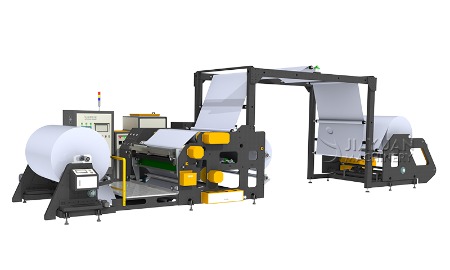
Adhesive coating machine
The transfer coating process offers several critical advantages over direct coating methods. First, it allows the adhesive to be coated under optimal conditions on a stable, smooth liner that provides a perfect surface for uniform adhesive deposition, independent of the facestock's surface roughness, porosity, or dimensional stability. This is particularly important for thin, extensible films (e.g., BOPP, PET) that would stretch or wrinkle under the tension required for direct coating. Second, transfer coating enables the production of double-sided tapes and transfer tapes, where the adhesive is coated onto both sides of a carrier or supplied as a free adhesive film. Third, the process allows separate optimization of the coating and lamination steps, improving overall quality and production efficiency. Fourth, transfer coating reduces waste because the liner can be used multiple times, and any coating defects are easily identified and isolated before lamination to the expensive facestock.
The equipment configuration for transfer adhesive coating typically includes a coating station (slot die, comma blade, gravure, or roll coater) where the PSA is applied onto the release liner. For hot melt PSAs, the system includes a melt tank, heated hoses, and a temperature-controlled die to maintain consistent viscosity. For solvent-based and water-based PSAs, a drying oven with multiple temperature zones follows the coating station to evaporate the carrier. After the adhesive is solidified, a lamination station brings the facestock (unwound from a separate stand) into contact with the adhesive-coated liner under controlled nip pressure and temperature. The nip pressure and temperature are adjusted to ensure complete adhesive transfer without bubbles or wrinkles. The finished labelstock or tape is then rewound with precise tension control. Key process parameters include coat weight (typically 15-30 gsm for labels), line speed (100-400 m/min for hot melt), nip pressure, and the release force of the liner (typically 5-15 g/25mm for easy peel).
The choice of adhesive and liner materials is critical in transfer coating. The release liner is typically glassine paper, poly-coated paper, or PET film with a silicone coating that provides a controlled release force. The silicone must be fully cured to prevent migration to the adhesive, which would reduce tack. For the adhesive, hot melt PSAs (SBC-based) are the most common for labelstock due to their solvent-free nature, high speed, and instant bonding. Water-based acrylic PSAs are used for applications requiring higher UV resistance and clarity, while solvent-based PSAs are reserved for specialty high-performance products. The facestock can be paper, film (BOPP, PET, PVC), foil, or nonwoven, depending on the end-use. The transfer coating process is essential for producing the vast majority of self-adhesive labels used in consumer goods, logistics, and industrial applications.
Quality control in transfer adhesive coating focuses on coat weight uniformity, adhesive transfer efficiency, and release performance. Coat weight is monitored online using beta or X-ray gauges, with cross-web profile control to correct variations. The release force of the liner is tested to ensure consistent dispensing performance. Adhesive transfer is verified by peel tests on the laminated product; the failure mode must be cohesive within the adhesive, not adhesive failure at the liner interface. The facestock must be free of wrinkles and properly aligned with the liner. Modern transfer coating lines incorporate inline vision inspection, automated defect marking, and data logging for traceability. The trend in transfer coating is toward thinner, more sustainable liners, lower coat weights to save material, and the use of bio-based and recyclable adhesives in response to environmental regulations.