transfer coater
A transfer coater is a specialized industrial coating machine that applies a coating material onto a temporary carrier substrate (typically a release liner) and then transfers that coating to a final substrate in a subsequent lamination step. This two-stage process is particularly common in the production of pressure-sensitive adhesive (PSA) tapes and labels, where the adhesive is first coated onto a silicone-coated liner, dried or cooled, and then laminated to the face material. This article provides a detailed overview of transfer coater technology, its working principles, advantages, process configurations, and key applications.
The transfer coating process involves two distinct stages. In the first stage, the coating (e.g., a PSA) is applied onto a release liner using any standard coating method such as slot die, comma blade, gravure, or roll coating. The coated liner passes through a drying oven (for solvent-based or water-based adhesives) or a cooling drum (for hot melt adhesives) to solidify the adhesive layer. In the second stage, the coated liner is laminated to the final substrate (facestock) under pressure, causing the adhesive to transfer from the liner to the substrate. The liner is then rewound for reuse or disposal. The key advantage of transfer coating is that the adhesive is coated under optimal conditions on a stable, dimensionally stable liner, independent of the final substrate's properties.
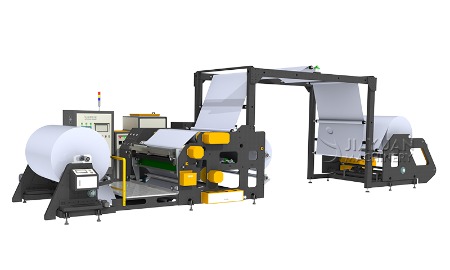
Adhesive coating machine
Transfer coaters offer several distinct advantages. They allow coating of adhesives onto substrates that are difficult to coat directly, such as thin, delicate films, textured materials, or substrates that are sensitive to heat or solvents. The liner provides a perfect surface for coating, ensuring uniform adhesive deposition and defect-free drying or cooling. Transfer coating also enables the production of double-sided tapes, where the adhesive is coated onto both sides of a carrier film using two separate transfer steps. The process allows separate optimization of the coating and lamination steps, improving overall quality and production efficiency. Additionally, transfer coating reduces waste because the liner can be used multiple times, and any coating defects are easily identified and isolated before lamination.
However, transfer coaters also have limitations. The process requires an additional lamination station, increasing machine complexity and floor space. The release liner must be carefully selected to provide the correct release force; too low release causes premature transfer, while too high release makes lamination difficult. The adhesive may not transfer completely, leaving residue on the liner (residual adhesion) which can cause defects. The lamination step must be precisely controlled to avoid wrinkles, bubbles, or misalignment, especially at high speeds. The release liner adds material cost, though it is typically recycled or reused. Transfer coating is generally slower than direct coating because of the additional processing step, and the overall yield can be affected by defects in either the coating or lamination stages.
Key components of a transfer coater include the coating station (where the adhesive is applied to the liner), the drying or cooling section (to solidify the adhesive), the lamination station (where the liner is combined with the facestock), and the rewind systems for both the finished product and the spent liner. The lamination station consists of a pair of nip rolls that press the coated liner against the facestock, with precise pressure and temperature control. A release roll may be used to separate the liner from the facestock after lamination, or the liner may be left on the product as a protective layer (as in many medical tapes). Modern transfer coaters incorporate tension control systems for both webs, automatic splices, and vision inspection for quality assurance. The coating and lamination speeds must be synchronized to prevent web breaks or telescoping.
Transfer coaters are widely used in the production of pressure-sensitive adhesive tapes, labels, and laminates. In the label industry, transfer coating is the standard method for producing self-adhesive label stock, where the PSA is coated onto a silicone liner and later laminated to the label face material. Double-sided tapes are produced by coating adhesive on both sides of a carrier film, often using two transfer coating stations. Medical tapes and dressings often use transfer coating to apply gentle adhesives onto breathable nonwoven substrates. In the graphic arts industry, transfer coating is used for mounting adhesives on foam boards and specialty media. The transfer coater's ability to decouple coating from substrate properties makes it an indispensable technology for many high-quality adhesive products, with continuous improvements in liner materials and process control enhancing its efficiency and versatility.