unwind tension
Unwind tension is the longitudinal force applied to the substrate web as it is pulled off the unwind roll at the beginning of the coating line. This tension is crucial for stable web feeding, preventing telescoping or damage to the unwinding roll, and ensuring consistent entry conditions for the coating station. This article provides a detailed technical overview of unwind tension, including its principles, control strategies, and impact on coating quality and roll handling.
The unwind station is the starting point of the coating line, holding the raw substrate roll and feeding the web into the process. Unwind tension must be high enough to keep the web taut and prevent sagging or wrapping around rolls, but low enough to avoid crushing the core or creating excessive tension that could stretch the substrate. The tension is typically controlled by a brake system (mechanical, pneumatic, or electric) applied to the unwind shaft, or by a driven unwind stand that acts as a motor in regenerative braking mode. As the roll diameter decreases during unwinding, the torque required to maintain a constant tension also decreases; this is because tension = torque / radius. Therefore, the control system must adjust the brake or motor torque inversely with the roll diameter. This is usually done by measuring the roll diameter (e.g., using ultrasonic sensors or counting revolutions) and calculating the required torque, or by using a dancer roll that directly senses tension and adjusts the brake accordingly.
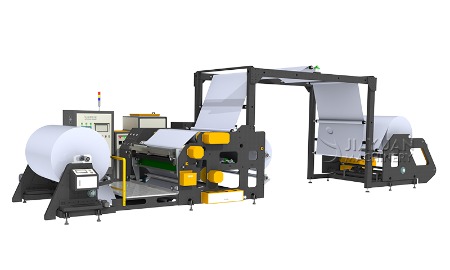
Adhesive coating machine
Constant tension control is the most common strategy for unwinding, ensuring that the web tension remains stable as the roll unwinds. However, constant torque control is also used for some applications, but it causes tension to increase as the roll diameter decreases, which is generally undesirable. The closed-loop tension control uses a load cell on an idler roll or a dancer roll to measure the actual tension, and the controller compares it with the setpoint, adjusting the brake or drive torque. The response time must be fast enough to compensate for changes in roll dynamics, such as inertia changes during acceleration. The unwind tension setpoint is determined by the substrate type and the line requirements. For thin, extensible films (e.g., 20 µm PET), tension is set low (e.g., 5-15 N per meter width), while for paper or heavy films, higher tension is used (e.g., 20-50 N/m). The tension must also be sufficient to overcome any friction in the web path and to ensure positive contact with the nip rolls at the coating station.
Improper unwind tension leads to several problems. If tension is too low, the web may wander laterally, causing misalignment with the coating head or edge guiding systems; it may also cause wrinkling due to lack of flatness. Low tension also makes it difficult to maintain good contact with the backup roll, leading to air entrainment and coating defects. If tension is too high, the web may stretch, reducing its width (necking) and altering the coat weight per area; it may also crush the cardboard core or cause the web to break at weak spots or splices. Excessive tension can also cause the roll to telescope (layers sliding sideways), damaging the roll and causing scrap. Therefore, the unwind tension must be carefully tuned for each substrate and line condition. In addition, the unwind station often includes an automatic splicing system to splice a new roll without stopping the line; during splicing, the tension must be momentarily controlled to prevent web breaks or tension spikes. This requires sophisticated control algorithms that manage the acceleration of the new roll and the deceleration of the old one.
Unwind tension also affects the coating process at the first coating nip. The web enters the coating station with a specific tension that contributes to the nip pressure. In roll coating, the unwind tension adds to the load between the applicator and backup rolls, influencing the coating penetration and film split. Therefore, changes in unwind tension can cause changes in coat weight and uniformity. In slot die coating, the web tension affects the contact with the backup roll; if tension is too low, the web may not be perfectly flat against the roll, causing the die gap to vary. Thus, the unwind tension setpoint is often correlated with the coating head parameters, and any drift in unwind tension is immediately reflected in coat weight measurements. Modern coating lines have integrated tension control where the unwind section is part of a master speed reference, and any changes in line speed are coordinated with torque adjustments to maintain constant tension.
Maintenance and monitoring of the unwind tension system are important. The brakes or drives must be periodically inspected for wear, and load cells must be calibrated. The roll diameter measurement system must be accurate; errors in diameter can cause tension drifts. Additionally, the web guide system (edge guide) is often integrated with the unwind tension control; if the web wanders due to tension variations, the guide compensates, but if tension is too low, the guide may not be able to correct. Operators monitor unwind tension through HMI displays and trend charts. Alarms are set for tension deviations beyond acceptable limits, prompting corrective actions. In summary, unwind tension is a fundamental control parameter that ensures stable web feeding, consistent coating application, and high-quality rewind rolls. Its precise control is essential for the overall efficiency and product quality of the adhesive coating line.