viscosity range
Viscosity range refers to the acceptable spectrum of adhesive viscosity values that can be processed on a given coating machine or with a specific coating method. Viscosity is a measure of a fluid's resistance to flow and is a critical rheological property that determines coating behavior, including flow uniformity, wetting, leveling, and defect formation. This article provides a comprehensive technical overview of viscosity ranges for different adhesive types and coating methods, measurement techniques, factors affecting viscosity, and its importance in process design and control.
Viscosity is typically measured in centipoise (cP) or Pascal-seconds (Pa·s), with 1 Pa·s = 1000 cP. The viscosity range suitable for a given coating method varies widely. Slot die coating can handle a broad range from 100 to 50,000 cP, but the optimal range for most adhesives is 500-5,000 cP, where stable beads and good uniformity are achieved. Comma blade coaters are also versatile, handling 100 to 50,000 cP, but they are less effective at very low viscosities due to dripping and at very high viscosities due to high pressure drops. Roll coaters (including reverse roll) can handle 50 to 50,000 cP, with excellent performance around 1,000-10,000 cP. Gravure coating is best for low to medium viscosities, typically 50-2,000 cP, because high viscosities do not fill the engraved cells properly and cause skipping. Spray coating is limited to low viscosities, usually below 500 cP, to achieve proper atomization. Hot melt adhesives are applied at elevated temperatures where their viscosity drops dramatically; typical application viscosities range from 500 to 5,000 cP at 150-180°C, although the solid-state viscosity is extremely high.
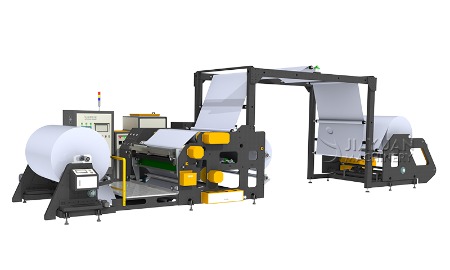
Adhesive coating machine
Viscosity is highly temperature-dependent; for most polymers, viscosity decreases exponentially with increasing temperature. This relationship is described by the Arrhenius equation or the Williams-Landel-Ferry (WLF) equation for near-Tg temperatures. For hot melt adhesives, a 5°C temperature change can alter viscosity by 10-20%, which directly affects coat weight and uniformity. Therefore, precise temperature control (within ±0.5°C) is essential for hot melt coating. For water-based and solvent-based adhesives, viscosity also depends on solids content, molecular weight, and the presence of additives (thickeners, rheology modifiers). As the solvent or water evaporates, the viscosity of the coating film increases dramatically, which can affect leveling and drying. Shear rate is another critical factor; many adhesives are non-Newtonian (shear-thinning or pseudoplastic), meaning their apparent viscosity decreases with increasing shear rate. Coating processes involve high shear rates (e.g., 10^3 to 10^5 s^-1 in roll nips or slot die channels), so the viscosity at the relevant shear rate must be measured, not just the zero-shear viscosity. Therefore, rheological characterization using rotational or capillary viscometers is essential for process design.
The viscosity range directly affects coating defects. If viscosity is too low, the adhesive may drip, run, or penetrate excessively into porous substrates, causing bleeding or strikes. Low viscosity also leads to poor leveling, resulting in orange peel or wavy surfaces. If viscosity is too high, the adhesive may not flow uniformly into the coating bead or die slot, causing streaks, missing coating, or excessive pressure that can damage the die lips or rolls. High viscosity also increases the load on pumps and may cause cavitation or pump slip. In slot die coating, the pressure drop through the die is proportional to viscosity and flow rate; excessive pressure can distort the die or cause leakage. In roll coating, high viscosity leads to thicker films and may cause uneven film splitting. Therefore, the adhesive formulation and application temperature must be selected to keep the viscosity within the optimum range for the chosen coating method.
Measurement of viscosity for coating applications is done using various types of viscometers. Brookfield viscometers (rotational) are common for low-shear viscosity measurement, but they do not capture shear-thinning behavior at process-relevant shear rates. Capillary rheometers or rotational rheometers with cone-plate or concentric cylinder geometries can measure viscosity over a range of shear rates, providing a full flow curve. For quality control in production, inline viscometers (e.g., vibrating or oscillating probes) can monitor viscosity continuously in the supply tank or circulation loop. These devices provide real-time feedback to adjust temperature or add solvent to maintain viscosity within the target range. Some advanced lines use closed-loop viscosity control where the inline viscometer signal controls the heater or solvent addition pump. This ensures that the adhesive entering the coating head has consistent rheology, reducing coat weight variations and defects. The target viscosity is typically specified with a tolerance (e.g., ±5%) based on process sensitivity studies.
The viscosity range also influences the design of the coating machine components. Pumps must be selected based on the viscosity and pressure requirements; gear pumps are suitable for most viscosities up to 50,000 cP, while screw pumps or piston pumps may be needed for higher viscosities. The piping and hoses must be heated or insulated to maintain temperature and prevent excessive pressure drops. The coating head (die, blade, rolls) must be robust enough to withstand the forces generated at high viscosity, and the backup roll may need a harder surface to avoid deflection. For hot melt systems, the melt tank and supply lines must be sized to provide sufficient residence time for heating and to handle the viscosity at the application temperature. In addition, the viscosity range affects the drying or cooling requirements; higher viscosity coatings tend to have higher solids content, reducing drying load. Therefore, selecting the appropriate viscosity range is a fundamental part of process optimization, balancing coating quality, speed, and energy efficiency, and is often a collaborative effort between the adhesive supplier and the coating equipment manufacturer.