water based adhesive coating machine
A water based adhesive coating machine is an industrial system that applies adhesives where water serves as the carrier medium, with the water subsequently evaporated in drying ovens to leave a solid adhesive layer. These machines offer a balance between performance and environmental compliance, producing lower VOC emissions than solvent-based systems while maintaining the ability to coat heat-sensitive substrates. This article provides a comprehensive overview of water based adhesive coating machine technology, including working principles, process parameters, advantages, and applications.
Water based adhesive coating machines operate by applying an aqueous adhesive solution (typically containing 40-60% solids) onto a moving substrate and then evaporating the water in a drying oven. The coating is typically applied using roll coaters, comma blade coaters, or gravure coaters, depending on the required coat weight and precision. After coating, the substrate passes through a drying tunnel (typically 5-30 meters) heated to 40-150°C to evaporate the water. The drying process is less energy-intensive than solvent-based systems because water has lower volatility and lower environmental impact, but it still requires significant energy and floor space compared to hot melt systems. The coated substrate is then rewound or passed to downstream processing such as lamination or slitting.
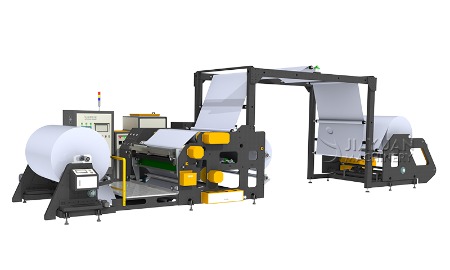
Adhesive coating machine
Water based adhesive coating machines offer several significant advantages. They produce low VOC emissions, making them environmentally preferable to solvent-based systems and compliant with increasingly strict air quality regulations. Water-based adhesives can be applied at room temperature, making them suitable for heat-sensitive substrates such as thin films, foams, and certain plastics. They can achieve high coat weights (up to 500 gsm) in a single pass, and many water-based adhesives can be crosslinked to achieve high heat resistance and durability. Water-based systems are also generally safer for operators than solvent-based systems, with lower fire and explosion risks. These machines are widely used for paper, film, nonwoven, and textile applications where environmental compliance and substrate compatibility are priorities. Common applications include BOPP packaging tapes, protective films, stationery tapes, and various laminating adhesives.
However, water based adhesive coating machines also have limitations. The drying process is slower than hot melt solidification, typically limiting line speeds to 30-150 m/min compared to 300-600 m/min for hot melt. The drying ovens consume significant energy—though less than solvent systems, still considerably more than hot melt. Water-based adhesives can cause wrinkling on non-porous substrates due to water absorption and subsequent drying shrinkage. They are generally water-sensitive unless crosslinked, limiting their use in moisture-exposed applications. The coating equipment must be constructed from corrosion-resistant materials to prevent damage from water exposure. Additionally, water-based adhesives often require biocides or antimicrobial additives to prevent bacterial growth in the adhesive supply system. Despite these limitations, water based adhesive coating machines remain an essential technology for many applications where environmental regulations or substrate sensitivity preclude the use of hot melt or solvent-based alternatives.
A typical water based adhesive coating machine includes a coating station (often using a comma blade or gravure coater), a drying oven with precise temperature and airflow control, and unwind/rewind stations with tension control. The comma blade coater is particularly common for water-based adhesives, using a precision blade to meter the adhesive onto the substrate at a controlled thickness. The drying oven is typically divided into multiple zones with independent temperature control to optimize drying without causing defects such as blistering or uneven solid deposition. The machine may also include corona treatment stations for substrate surface activation, laminating stations for combining multiple layers, and slitting stations for converting the coated web into finished products. Modern water based adhesive coating machines incorporate PLC-based control systems for automated process management, including closed-loop coat weight control, tension regulation, and oven temperature profiling. The growing demand for sustainable packaging and eco-friendly products continues to drive innovation in water based adhesive coating technology.