web tension
Web tension is the longitudinal force applied to the substrate web as it travels through the coating machine, typically measured in Newtons (N) or pounds-force (lbf). Proper tension control is essential for maintaining web stability, preventing wrinkles and breaks, ensuring accurate coating application, and achieving quality rewind rolls. This article provides a comprehensive technical overview of web tension in adhesive coating, including its principles, measurement, control methods, and impact on coating quality.
Tension is the force per unit cross-sectional area that stretches the web. In a typical coating line, tension must be maintained at a level sufficient to keep the web flat and stable against rolls, but not so high as to stretch or deform the substrate, especially for thin films which are highly extensible. The optimal tension varies with substrate type, width, thickness, and line speed. For example, a 50 µm PET film may require a tension of 0.5-1.0 N per centimeter of width, while a paper substrate may need higher tension (2-5 N/cm) due to its lower stiffness. Tension is generated by the differential speed between driven rolls (e.g., pull rolls) and the unwind or rewind stands. In a multi-zone line, each section (unwind, coating, drying, rewind) may have independent tension control to accommodate the changing web properties as it passes through heating and coating. Improper tension causes numerous defects: low tension leads to web wander, wrinkles, and poor nip contact; high tension causes stretching, necking, and even breakage, especially at splices or weak spots. Thus, tension control is a cornerstone of reliable coating line operation.
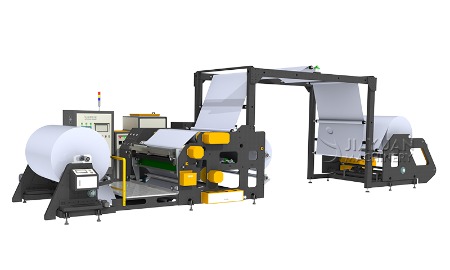
Adhesive coating machine
Tension measurement is performed using load cells (force transducers) mounted on idler rolls. The web wraps around the idler roll, and the resultant force is measured, with the tension calculated from the wrap angle. Alternatively, dancer rolls (pivoting arms with a roll) are used; they provide a tension indication based on the air pressure or spring force required to hold the dancer in position. Load cells offer precise, real-time measurement and are preferred for closed-loop control. The tension measurement is typically taken at multiple points along the line to monitor and control each zone independently. The control system compares the measured tension with the setpoint and adjusts the speed of the driven rolls (e.g., the pull roll after the coating station, or the rewind drive) to maintain the target. PID controllers are standard, but modern systems use advanced algorithms such as cascade or feed-forward control to compensate for speed changes, roll inertia, and web elasticity. Tension control is especially challenging during acceleration and deceleration because the web's elastic behavior causes transient tensions; therefore, most lines have tension ramp profiles that change gradually to avoid shock loads.
Web tension affects coating quality in several ways. In slot die coating, the backup roll must have a precise surface, and the web tension must be sufficient to maintain intimate contact between the web and the roll, preventing air entrainment or gap variations. If tension is too low, the web may lift off the roll, causing coating defects. In roll coating, the nip pressure is influenced by web tension; high tension increases the effective nip load, which can affect coating penetration and transfer. In gravure coating, tension affects the wrap angle and pressure between the web and engraved cylinder, influencing transfer efficiency. In drying ovens, the web tension must be carefully controlled to prevent sagging between rolls (which causes uneven drying) or flutter (which can cause the web to touch oven walls). Tension also affects the final rewind roll quality; too low tension results in loose, telescoped rolls, while too high tension causes hard rolls that may block or crush the adhesive. Therefore, proper tension management is essential for both the coating process and the downstream converting operations.
Factors that influence web tension include substrate properties (modulus, thickness, width), line speed, temperature, and splices. Substrates with low modulus (e.g., LDPE, soft films) are more sensitive to tension and require low tension to avoid stretching; they also exhibit viscoelastic behavior, where the tension depends on the speed and history. Temperature from drying ovens can soften the substrate, reducing its modulus and making it more prone to stretching; thus, tension in the oven section is often lower than in the coating section. Splices (tape joints) create a localized stiffness change that can cause tension spikes; the control system must handle splices smoothly, often by temporarily reducing speed or tension. Additionally, the web width and thickness variations can change the effective tension per unit area; the control system must maintain total tension (force) constant, which means that tension per width may vary if width changes, but this is generally avoided by using constant width lines.
Modern tension control systems integrate with the overall line automation. They communicate with the line speed control to synchronize all drives. They also interface with the coat weight control system, as tension changes can affect the substrate surface speed relative to the coating head, altering the effective coating thickness. Some advanced systems include an elastic model of the web to predict tension behavior and preemptively adjust drives during transients. Maintenance of tension control components (load cells, dancer cylinders, drive motors) is essential; calibration of load cells is performed with known weights, and dancer bearings must be free-moving. In summary, web tension is a dynamic, multifaceted parameter that requires robust measurement, precise control, and a deep understanding of substrate mechanics. Proper tension control is indispensable for achieving high coating quality, minimal waste, and efficient production in adhesive coating lines.