wet coat thickness
Wet coat thickness is the thickness of the adhesive layer immediately after application, before any drying or curing occurs, when the coating still contains all solvents, water, or other volatile carriers. It is a critical parameter for solvent-based and water-based adhesive coating processes because it determines the drying load and influences the final dry coat weight and coating uniformity. This article provides a comprehensive technical overview of wet coat thickness, including its measurement, relationship to dry coat weight, factors affecting it, and its importance in process control and equipment design.
Wet coat thickness is typically expressed in micrometers (µm) or mils, and it is always greater than the final dry coat thickness because the volatile components are removed during drying. The relationship between wet and dry thickness is: dry thickness = wet thickness × solids fraction (volume basis), or in terms of weight: dry coat weight (gsm) = wet coat weight (gsm) × solids weight fraction. For example, a 50% solids water-based adhesive applied at a wet thickness of 50 µm (density ~1.0 g/cm³, so wet coat weight ~50 gsm) will yield a dry thickness of approximately 50 × 0.5 = 25 µm, assuming no density change. For solvent-based adhesives with lower solids (e.g., 30%), the wet thickness is much higher than the dry thickness. Typical wet thicknesses for PSA applications can range from 30 to 200 µm, depending on the solids content and desired dry coat weight. In hot melt coating, there is no wet thickness as such, because there are no volatiles; the applied thickness is the final thickness.
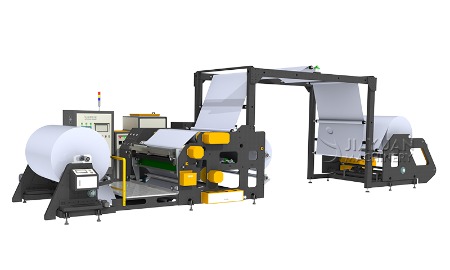
Adhesive coating machine
Measurement of wet coat thickness is challenging because the coating is liquid and sensitive to contact. Online measurement is typically done using non-contact optical methods such as laser triangulation, interferometry, or capacitive sensors. Laser profilometers can scan across the web to measure the height of the liquid layer relative to the substrate surface, providing a real-time wet thickness profile. This is particularly useful for closed-loop control, especially when the drying oven is long and feedback from dry coat weight (measured at the oven exit) would have too much delay. However, optical measurements can be affected by the surface roughness of the liquid, color, or transparency. Offline measurement is often done using a wet film comb or a micrometer on a freshly coated sample, but these methods are destructive and not suitable for continuous production. In practice, many manufacturers rely on the correlation between wet coat weight (measured by the flow rate and line speed) and the dry coat weight (measured after drying), using the known solids fraction to calculate wet thickness. The flow rate from the gear pump is a direct measure of wet coat weight, and with the line speed, the wet coat weight per unit area can be calculated. This indirect method is reliable if the pump calibration and solids fraction are accurate.
Wet coat thickness is a key parameter in drying oven design and operation. The drying oven must evaporate the volatile carrier at a rate that matches the wet coat thickness and line speed. The required oven length and temperature are determined by the wet thickness, the solvent or water content, and the maximum allowable substrate temperature. A thicker wet coating requires more energy and longer residence time to dry completely, and if the oven is undersized, the solvent may remain in the coating, causing defects such as blistering or poor adhesion. Conversely, if the oven is too hot or too long, the substrate may be damaged or the adhesive may crosslink prematurely. Therefore, the wet coat thickness must be controlled within a narrow range to ensure consistent drying and product quality. Additionally, the wet thickness affects the coating bead stability in slot die and roll coating; higher wet thicknesses may cause dripping, sagging, or edge beads, while very low wet thicknesses may lead to incomplete coverage or pinholes.
Factors affecting wet coat thickness are similar to those affecting coat weight, including pump flow rate, line speed, adhesive solids and density, and substrate absorption. For a given solids fraction, the wet coat weight is directly proportional to the pump flow rate and inversely proportional to the line speed. Therefore, speed changes must be compensated by flow adjustments to maintain constant wet thickness. Temperature affects the density and viscosity of the liquid, which in turn affects the flow measurement and the actual coating thickness. In roll coating, the wet thickness is also influenced by the roll gaps and speed ratios. Substrate porosity can absorb some of the liquid, effectively reducing the wet layer on the surface, which can cause confusion in measurement; for porous substrates, the wet thickness measured optically may not correspond to the amount of liquid applied because some penetrates. In such cases, the total wet coat weight (including penetration) is more relevant, and the drying load must account for the absorbed portion.
Control of wet coat thickness is often integrated with the overall coat weight control. For solvent-based lines, a wet thickness gauge can be placed immediately after the coating head to provide fast feedback, while the dry thickness gauge at the oven exit provides the ultimate verification. The wet gauge can detect deviations due to pump pulsation or speed changes quickly, allowing rapid correction before the defective material reaches the oven and becomes scrap. Some advanced systems use model-based control that predicts the dry coat weight from the wet measurement and the drying conditions, enabling feed-forward compensation. Additionally, the wet thickness profile across the web can be used to adjust the die gap or other profile actuators, ensuring that the drying load is uniform across the width. In summary, wet coat thickness is a vital intermediate parameter that bridges the coating application and drying processes, and its precise control is essential for achieving the final dry coat weight specification while maximizing line efficiency and minimizing defects.